

Transportation woes compound difficulties scheduling appointments
Majorities say policies like more microtransit, telehealth would help their communities
Residents of rural areas face unique and multifaceted challenges accessing health care, according to a survey released today. These include long waits to see a doctor, as well as long distances residents need to travel for appointments. For many, and especially those in worse health, problems with transportation are leading to rescheduled, missed, or skipped care, as well as stress and anxiety.
These are some of the findings from a new survey of 600 residents of rural communities in Massachusetts out today. The survey was accompanied by a focus group with rural residents. The research project was conducted by The MassINC Polling Group for Transportation for Massachusetts (T4MA) and sponsored by The Health Foundation of Central Massachusetts.
The findings are being discussed today at a webinar, part of Transportation for Massachusetts’ ongoing Money Train learning series about transportation funding.
Most rural residents surveyed report at least one transportation-related challenge accessing health care. In the past year, 55% of rural Massachusetts residents have had to reschedule an appointment due to a problem with transportation. Another 43% have felt stressed or anxious getting to an appointment. And smaller but still significant percentages have skipped appointments (33%), been late (29%), or declined care altogether (23%).
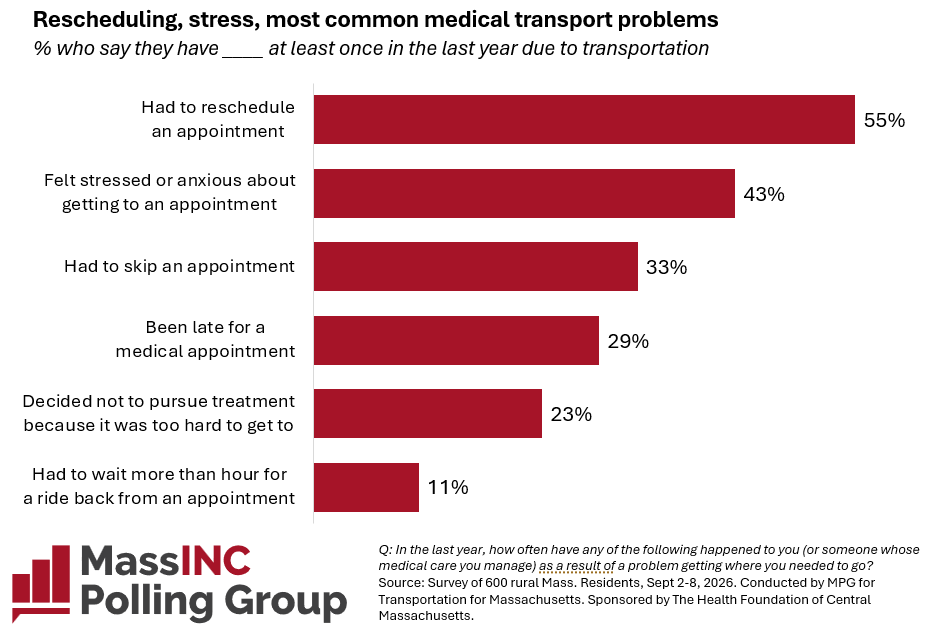
These problems are more common among those in worse health: 76% of residents who rated their physical health as fair or poor have had to reschedule an appointment due to transportation problems.
Transportation problems can compound what residents say is their most pressing health care issue: difficulty getting seen by doctors in the first place. Nearly half (48%) say they waited more than a month for their most recent appointment with a specialist. In the four counties of Western Massachusetts, 35% waited longer than 2 months. Distance is also a factor: 38% of rural residents have traveled more than 25 miles to see a specialist (49% in Western Massachusetts).
“Doctor’s appointments can be hard to come by and hard to get to in many rural communities, and having to reschedule due to a lack of transportation can push care out weeks or months further,” notes MPG Vice President Rich Parr, who conducted the research. “These problems with health care access are very much interconnected.”
The survey included an oversample of 100 additional residents from Worcester county. These residents were less likely to cite challenges with access or wait times. Instead, their top challenge involved the cost of health care (23%), compounded by complaints about insurance (17%). When they did have trouble with transportation to health care, Worcester residents were less hindered by the distance or time traveled than Western Mass residents (14% versus 21%) and more likely to cite challenges with traffic (18%) or other problems related to driving, like getting lost or parking (16%). Worcester residents were also more likely to have utilized telehealth in the past year compared to Western Mass rural residents (57% versus 48%).
“There are health care access challenges across Massachusetts, but these challenges are heightened for rural residents and further exacerbated by the lack of affordable and reliable transportation in rural regions of the state,” said Amie Shei, President and CEO of The Health Foundation of Central Massachusetts. “In order to improve health, we need to address health care access challenges and also invest in social determinants of health like transportation to ensure that residents can receive health care when they need it.”
For some patients, not being able to get to appointments is having a real impact on their health. Among the residents who reported a transportation problem, a third (34%) said it had a negative impact on their health. Those reporting the longest wait times and travel distances were more likely to report adverse health effects.
Recent reports for T4MA by the UMass Donahue Institute highlighted the economic cost to health care providers of missed appointments. Transportation problems causing patients to miss appointments can make it harder for the relatively few doctors in rural areas to stay afloat. If they close, rural patients will face even longer wait times and travel distances.
A focus group conducted alongside the survey shed light on the personal stakes of not being able to access health care. One participant who had moved to Western Massachusetts from New York recounted his challenges finding a doctor who takes Medicare: “I moved here from New York in March. I looked for a physician. I found one, eventually, and my first appointment was scheduled September. Then it was postponed to December. Thank God I'm mostly healthy. I think there's generally a problem everywhere. There aren't quite enough doctors, or healthcare workers.”
Another woman from the Hilltowns talked about the challenges of filling a prescription: “I'm pretty much equidistant between Greenfield, Pittsfield, and Northampton. It's a 45-minute drive to any of those places. I have a prescription that can only be filled every 10 days because of my insurance, and so that requires me to make an extra trip down. I'll try to plan it so I can get a tank of gas at the same time.”
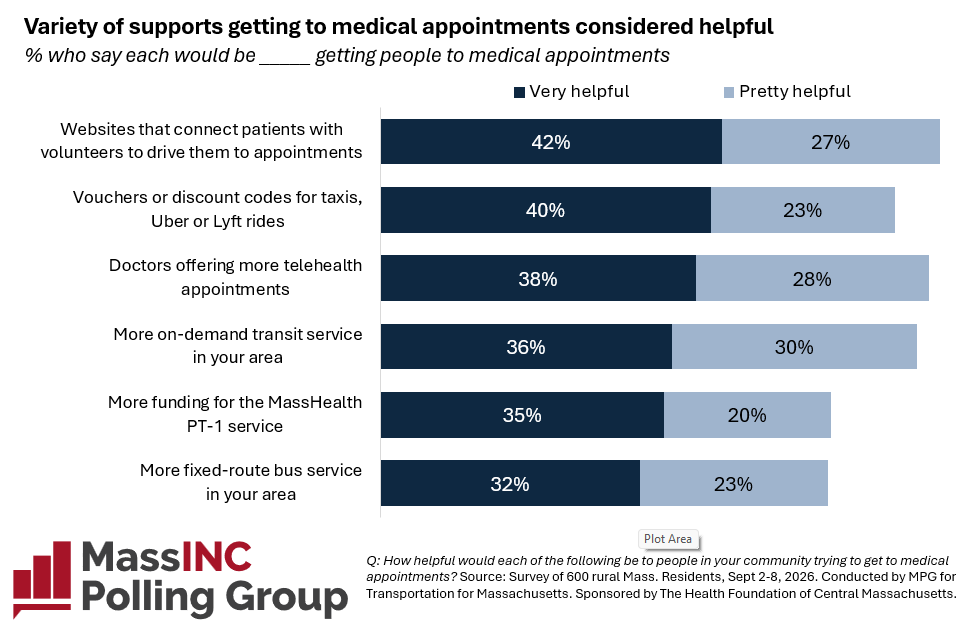
In light of these challenges, majorities polled think that various policies to improve transportation to health care would be helpful in their communities, including websites to connect patients with volunteer drivers (68%), more telehealth (67%), more on-demand transit service (66%), vouchers or discounts for ridehailing apps (63%), and more fixed-route public transit (55%).
Focus groups participants were supportive of more state investment in microtransit (on-demand transit using vans or smaller buses). One participant liked that it would provide relief for those taking care of aging relatives:
“There's a need where elders just having their license dropped, or not being able to drive, but yet not fully in a nursing home. They need to be able to have that mobility without making them feel like they don't matter.” said a focus group participant from Western Mass. “Because their care is like, I don't know. 10 or 12 of doctor's visits a year. That's family members pulling out of the workday, away from the kids, having to manage all that.”
“We’ve seen that microtransit services are lifelines for residents across the state, especially in rural areas, who do not have other options to get where they need to go to care for themselves and their families,” noted Reggie Ramos, Executive Director of Transportation for Massachusetts. “The challenge is no longer proving that micro-transit has value. It is giving successful programs the stability and capacity to serve the people already asking for rides. It is incumbent upon state leaders to prioritize sustainable funding so these services can continue.”
The survey found that half (49%) of rural residents are managing the health care of someone other than themselves, whether that be children or older relatives. These respondents were more likely to cite transportation challenges than those only managing their own care.
About the poll
These results are based on a survey of 600 residents of rural towns in Massachusetts, including an oversample of 100 rural residents from Worcester County. Responses were collected from September 2-8, 2026, via live telephone interviews, text messages and online panel sample. Worcester County residents were weighted separately and then incorporated with other responses proportionally. Responses were weighted by race, age and gender, education and geography, to reflect known and estimated population parameters for Massachusetts residents. The margin of error for this survey is +/- 4.5 percentage points at the 95% confidence level, inclusive of the design effect. The survey was conducted by The MassINC Polling Group. This project was sponsored by The Health Foundation of Central Massachusetts and conducted for Transportation for Massachusetts.