

Massachusetts voters support state oversight of powerful AI models to mitigate risks of catastrophic impacts
New poll shows Massachusetts voters use AI regularly, but fear potential catastrophic impacts if tools are allowed to develop without government oversight.
As state lawmakers consider AI safety legislation on Beacon Hill, a new poll released today shows that Massachusetts voters are deeply concerned about the potential damage powerful AI models could cause without government regulation. Without regulation, 82% say it is very or somewhat likely that AI tools will create serious risks, such as enabling chemical, biological, radiological, or nuclear harms, large-scale cyberattacks, or other events causing widespread harm. When asked about a specific set of proposed regulations that Massachusetts lawmakers are currently considering to address these risks, 75% say they would support the package compared to 13% who offered opposition (see chart or topline for full question wording).
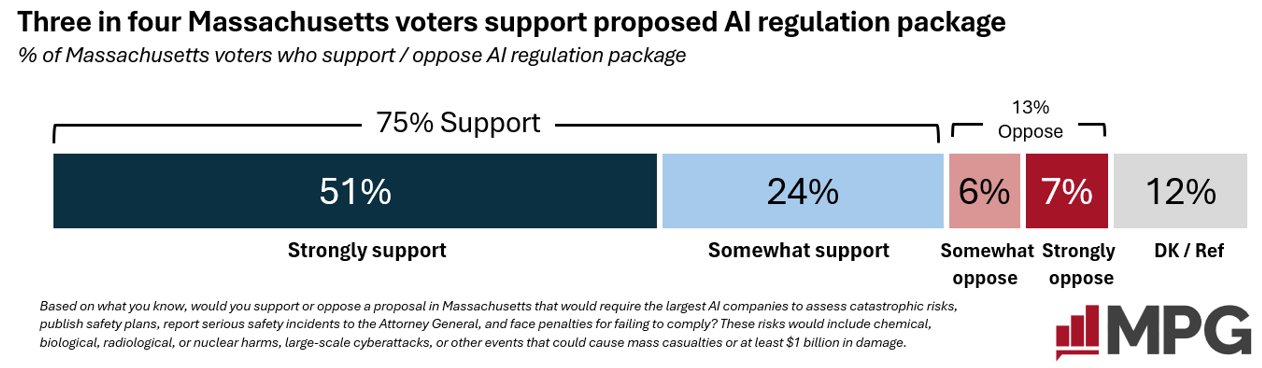
While several other states have passed their own AI regulations packages, such rules are not in place in most states at this point. Even so, 70% of Massachusetts voters are ready to take the lead without waiting for other states, while 15% say we should wait for other states. Similarly, 66% would rather move ahead before the federal government.
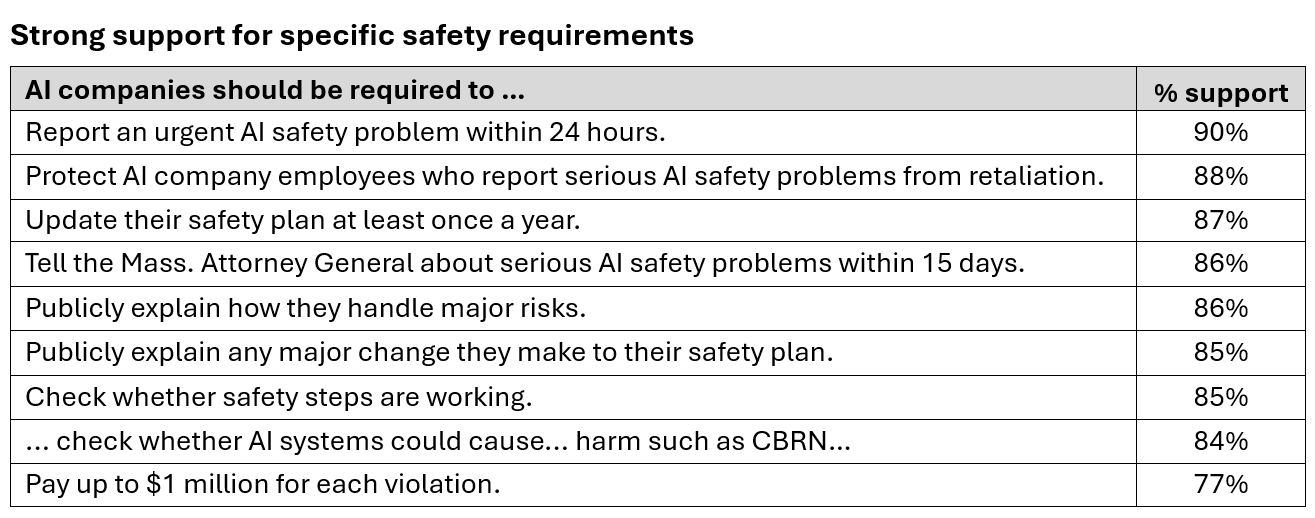
Support is not limited to the general idea of AI regulation, extending instead to specific legislative proposals. When presented with 9 specific items from proposed Massachusetts legislation, majorities say they would “strongly support” each, rising to 77% or more total support. These regulations included a range of reporting requirements, internal checks, public disclosure requirements, and a fine structure for violations.
“This survey is the first of its kind in Massachusetts,” said Steve Koczela, President of The MassINC Polling Group. “It shows a voting public looking to establish rules and oversight over powerful AI tools.”
In terms of enforcement, most voters would rather see either a new state agency or commission hold responsibility (39%) or the Attorney General’s office (33%). Just 13% say AI companies “should mostly enforce their own rules.” On another question, just 23% agreed that “AI companies should be responsible for ensuring the safety of their own models without government interference” while 59% said "government should oversee AI companies who are deploying models that create serious risks.”
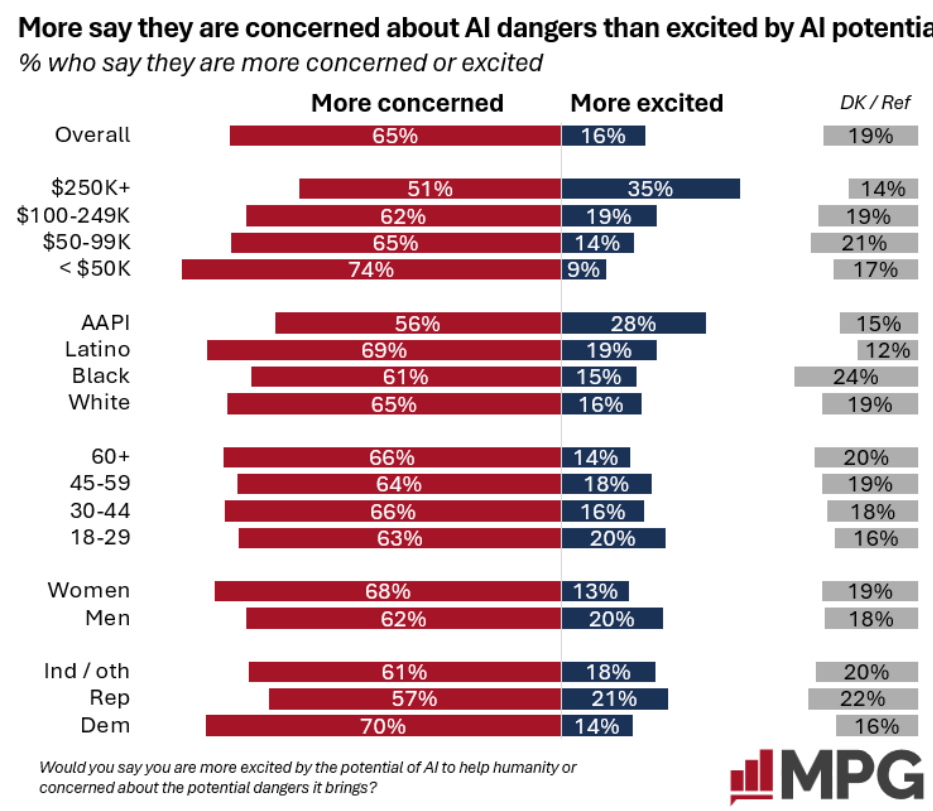
The reasons behind support for regulation are reflected in several other questions in the survey. Far more say they are concerned about the damage AI could cause (65%) than are excited about the benefits it could bring (16%), adding urgency to the task of creating safety rules. This view extends across every demographic group included in the survey. Republicans (57%) and voters in higher income households (51%) were least likely to say they were “concerned,” but even among these groups, far more are concerned than excited.
About the poll: These results are based on a survey of 1,264 Massachusetts registered voters conducted June 23 – July 1, 2026. The registered voter sample was drawn from the state voter file and respondents were contacted via live telephone interviewers, text-to-web, and online survey. The survey included an oversample of Black, Latino, and AAPI voters to bring each up to at least 150 respondents. Oversamples were weighted to target parameters on age, gender, and education level. The total sample was then weighted by race, age and gender, education, political party, and geography, to reflect known and estimated population parameters for Massachusetts registered voters. The margin of error for this survey is +/- 3.7 percentage points at the 95% confidence level, inclusive of the design effect. This project was conducted by The MassINC Polling Group and sponsored by Anthropic.
About The MassINC Polling Group: The MassINC Polling Group (MPG) is a nonpartisan public opinion research firm serving public, private, and social-sector clients. MPG elevates the public’s voice through rigorous analysis and innovative research methods. Based in Boston, MPG serves a nationwide client base. Learn more at massincpolling.com.